
Understanding bottle-to-carton line integration for pharmaceutical applications
A pharmaceutical packaging engineer recently described a familiar challenge: “Our bottle filler runs at 200 bottles per minute. Our cartoner is rated for 300 cartons per minute. On paper, the line should fly.
But in reality, the cartoner constantly starves, bottles back up at the transfer point, and we’re lucky to get 150 finished cartons per minute.” This gap between individual machine ratings and actual line output is one of the most common—and costly—problems in pharmaceutical packaging. Integrating a bottle filler with an automatic cartoner is not simply about connecting two machines with a conveyor. It requires careful attention to speed matching, buffer design, control system integration, changeover coordination, and serialization.
This guide walks through the key principles of bottle-to-carton line integration for pharmaceutical applications, drawing on industry benchmarks and real-world case studies.
 Why Pharmaceutical Bottle Lines Present Unique Integration Challenges
Pharmaceutical bottle packaging lines differ from other industries in several critical ways. Understanding these differences is the first step toward effective integration.
| Challenge | Pharmaceutical Context | Impact on Integration |
|---|---|---|
| Small batch sizes | Growing demand for specialized medicines leads to batches under 3,000 bottles | Frequent changeovers require rapid reconfiguration |
| High SKU variety | 500+ SKUs and 170+ bottle configurations are not uncommon | Line must handle broad size ranges without extensive format parts |
| Serialization mandates | EU FMD, US DSCSA require unique identifiers on each saleable unit | Cartoner must integrate with vision systems and track-and-trace software |
| Regulatory compliance | cGMP, 21 CFR Part 11, Annex 11 require validated processes and data integrity | Control systems must support audit trails and electronic signatures |
| Product protection | Tablets and capsules are sensitive to impact and contamination | Gentle handling and cleanroom compatibility are non-negotiable |
The industry is responding to these challenges with new approaches. A 2025 PMMI report on pharmaceutical manufacturing trends highlights that operational complexity in pharmaceutical packaging is intensifying, with manufacturers facing mounting pressures from compliance requirements and the need for greater flexibility. The report notes that packaging line modernization is a key investment priority as companies seek to balance regulatory demands with operational efficiency.
The Four Pillars of Bottle-to-Carton Line Integration
Effective integration rests on four pillars: speed synchronization, buffer management, unified control, and changeover coordination.
Pillar 1: Speed Synchronization – Matching Filler Output to Cartoner Capacity
The most fundamental integration task is ensuring that the cartoner’s sustainable speed matches the filler’s sustainable output—not the rated speed of either machine.
Sustainable Output = Rated Speed × (1 – Total Downtime %)
A filler rated at 200 bottles/min with 15% total downtime delivers 170 bottles/min sustainably. A cartoner rated at 300 cartons/min with the same downtime delivers 255 cartons/min. The line’s maximum sustainable output is 170 cartons/min—the filler’s output—because the cartoner cannot run faster than bottles arrive.
The 10–20% Rule: The cartoner should be 10–20% faster than the filler’s sustainable output. This allows the cartoner to clear small upstream interruptions without starving. A cartoner that is significantly faster than the filler will simply sit idle—capacity you paid for but cannot use.
Industry guidance from ISPE confirms that “seldom does the output rate of the primary packaging equipment match the secondary packaging equipment”. This mismatch is exactly why intentional speed synchronization and buffer design are essential.
Pillar 2: Buffer Management – Absorbing Fluctuations
No matter how well you match speeds, minor fluctuations will occur. A buffer or accumulation zone between the filler and cartoner absorbs these fluctuations.
| Buffer Type | How It Works | Best For |
|---|---|---|
| In-line accumulation table | Bottles accumulate on a conveyor section; sensors control start/stop | Moderate speed differences; simpler lines |
| Turntable accumulator | Bottles spiral on a rotating table; first-in, first-out | High speeds; space-constrained lines |
| Zero-pressure accumulation | Sensors maintain gaps between bottles; no bottle-to-bottle contact | Fragile bottles; pharmaceutical applications |
Sizing Your Buffer: A general guideline is to size the buffer for 2–3 minutes of filler output at full speed. For a 170 bottles/min filler, this means 340–510 bottles of buffer capacity. This gives the cartoner enough time to clear minor jams without starving, and gives the filler enough time to restart after a brief stop without over-pressuring the cartoner.
Pillar 3: Unified Control – The “Single Brain” Approach
The most advanced integration strategy uses a unified control system that manages both the filler and the cartoner—and ideally the entire line.
| Control Approach | How It Works | Advantages |
|---|---|---|
| Independent controls | Each machine has its own PLC; manual speed matching | Simple; low initial cost |
| Linked controls | Machines share speed signals via communication protocols | Better coordination; automatic speed following |
| Unified line control | Single control system manages all machines; recipe-based operation | Seamless synchronization; data collection; remote access |
The 2025 ISPE Facility of the Year Award (FOYA) winner—Johnson & Johnson’s flexible bottle packaging line in Latina, Italy—demonstrates the power of unified control. The line is structured in modular cells, all managed by a “unique brain, a unique control system that controls the entire line, and it is integrated with the upper-level systems to receive orders, production data, and recipes”. This single control system enables seamless automation with robotics integration, including the oversight of 17 robots.
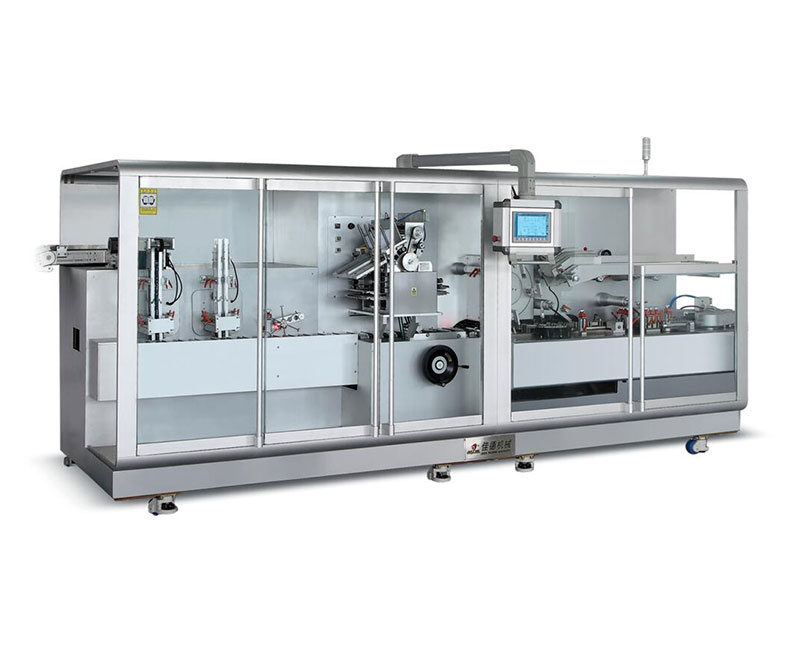
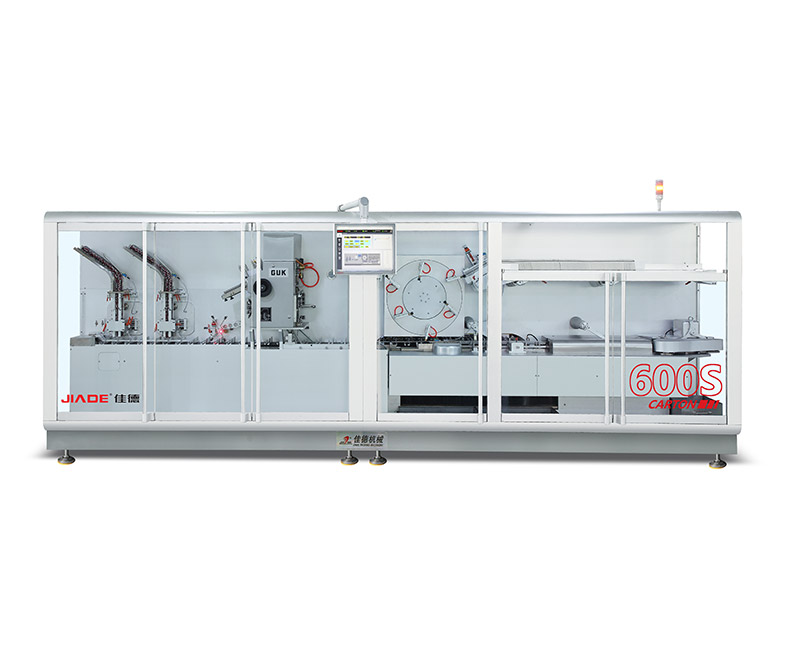
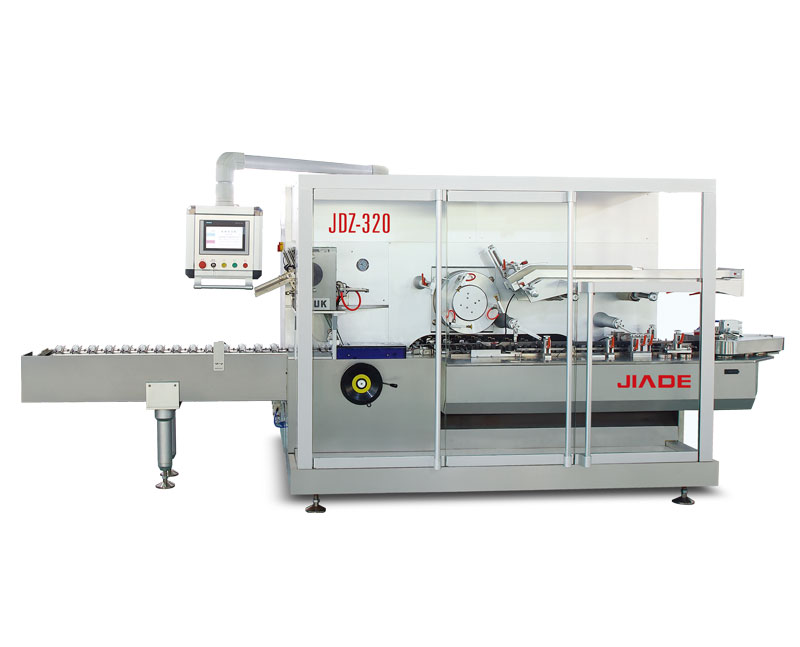
For a detailed look at how unified control principles are applied in cartoning systems, you can explore automatic cartoning machine designs with PLC-based automation and HMI integration.
Pillar 4: Changeover Coordination – The Hidden Bottleneck
Speed matching matters during steady-state production. But changeover synchronization often determines whether your line can actually achieve its target output across multiple SKUs.
The Changeover Challenge:
| Scenario | Filler Changeover | Cartoner Changeover | Line Impact |
|---|---|---|---|
| Staggered changeovers | 30 minutes | 45 minutes | 45 minutes total downtime |
| Coordinated changeovers | 30 minutes | 30 minutes (prepared in parallel) | 30 minutes total downtime |
| Integrated changeover | 15 minutes (recipe-driven) | 15 minutes (recipe-driven) | 15 minutes total downtime |
The Benchmark: The ISPE FOYA-winning line achieved changeover time reduction from 6 hours to 45 minutes—a dramatic improvement enabled by a line designed with no format parts and a unified control system. The line is capable of managing any packaging configuration without the need for format parts or human intervention.
While this is a highly advanced example, the principle applies at any scale: coordinated changeovers are faster than sequential changeovers.
Serialization Integration – The Regulatory Imperative
Serialization is not optional in pharmaceutical packaging. EU FMD and US DSCSA require that each saleable unit carry a unique identifier, and the cartoner must integrate with the systems that apply, read, and report these identifiers.
Key Serialization Integration Points:
| Integration Point | What It Does | Why It Matters |
|---|---|---|
| 2D DataMatrix printing | Prints a unique code on each carton | Enables unit-level traceability |
| Vision verification | Reads and verifies each code | Ensures code quality and readability |
| Aggregation | Links individual cartons to cases and pallets | Enables supply chain visibility |
| EPCIS reporting | Reports serialization data to cloud-based systems | Meets regulatory reporting requirements |
A 2025 case study on pharmaceutical serialization highlights that helper code integration—where a unique code printed on a bottle cap is married with the serialized Data Matrix code on each label—is essential for accurate tracking. This level of integration requires close coordination between the filler (where labels are applied) and the cartoner (where cartons are coded and verified).
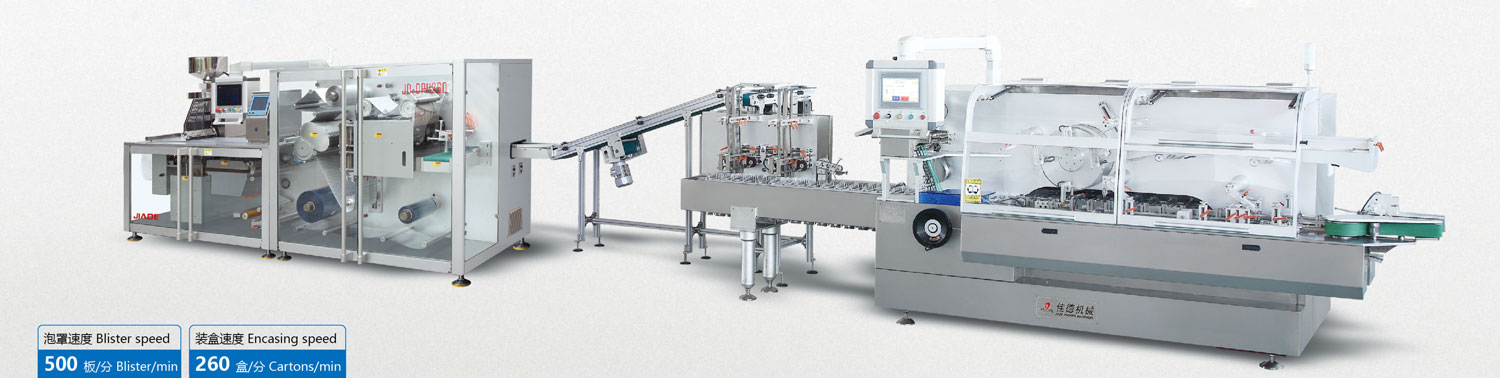
For a comprehensive view of how serialization fits into pharmaceutical packaging lines, you can explore integrated packaging line configurations that combine blister forming, cartoning, and serialization modules for end‑to‑end traceability.
Practical Application: The ISPE FOYA Case Study
The Johnson & Johnson Latina facility provides a real-world benchmark for bottle-to-carton line integration.
The Challenge:
-
Growing demand for specialized medicines in oncology, immunology, and neurology
-
The existing machinery setup was no longer suitable for flexible packaging
-
Need to handle batches under 3,000 bottles, 500 SKUs, and 170 bottle configurations
The Solution:
-
A fully automated robotic line with 17 robots in a row
-
Modular cells for primary (bottling), secondary (cartoning), and tertiary (palletizing) packaging
-
Unified control system integrated with upper-level systems for order, production data, and recipe management
-
No format parts—the line adapts to any bottle size without changing parts
The Results:
-
Changeover time reduced from 6 hours to 45 minutes
-
Significantly improved throughput for small to medium batches
-
In-line IPC ensures 100% unit inspection
-
Short delivery times accelerate time to patients
This case study demonstrates that the most advanced bottle-to-carton integration is not about connecting machines—it is about rethinking the entire line as a single, coordinated system.
For facilities evaluating complete packaging lines, exploring integrated pharmaceutical solutions for complex production environments can help you understand how cartoner selection fits within a broader line strategy.
Common Integration Mistakes and How to Avoid Them
Mistake #1: Sizing the Cartoner to the Filler’s Peak Speed
Buying a cartoner that matches the filler’s peak speed (not sustainable speed) means paying for capacity you cannot use. The filler will rarely run at peak, and the cartoner will spend most of its time idle.
Mistake #2: Skipping the Buffer
A buffer is not optional—it is essential. Without a buffer, any brief stop on either machine stops the entire line. With a properly sized buffer, minor interruptions are absorbed without line-wide downtime.
Mistake #3: Treating Changeovers as Independent Events
If the filler and cartoner change over at different times or speeds, the line’s total changeover time is the sum of both—not the longer of the two. Coordinate changeovers to run in parallel.
Mistake #4: Ignoring Serialization Integration Until the End
Serialization requirements affect machine selection, control system design, and line layout. Address serialization early in the integration planning process.
Mistake #5: Overlooking the Discharge Side
Synchronization does not end at the cartoner discharge. The cartoner must also sync with downstream equipment like bundlers or case packers.
Next Steps: From Integration Principles to Line Design
By now, you should have a clear framework for integrating a bottle filler with an automatic cartoner in pharmaceutical applications:
| Integration Pillar | Key Consideration |
|---|---|
| Speed synchronization | Match sustainable output, not rated speed |
| Buffer management | Size for 2–3 minutes of filler output |
| Unified control | Single control system for seamless coordination |
| Changeover coordination | Parallel planning; recipe-based changeovers |
| Serialization | Integrate printing, vision, and aggregation early |
Once you have established your target line speed, buffer requirements, and changeover frequency, the next logical step is to compare specific machine configurations against these criteria. You can review cartoning equipment options categorized by sustainable speed range and changeover flexibility to see which models align with your filler output and format range.
For facilities evaluating complete pharmaceutical packaging lines that include bottle filling, cartoning, and downstream packaging, exploring integrated packaging solutions can help you understand how cartoner selection fits within a broader line strategy—including how unified control systems manage the entire workflow from filler to palletizer.
Related Reading
-
How to sync an auto cartoner with a bottle filler for max output
-
How to pick an automatic cartoning machine for pharmaceutical lines
-
What speed range do you need from an automatic cartoning machine?
-
Exploring monoblock configurations for space-constrained high-speed lines
-
How to evaluate the true cost of downtime in packaging operations